I wrote this for my spring 2026 section of Masterpieces of Western Art at Columbia. A lot of what I write here is probably influenced by this excellent article, which I read before viewing this mosaic in person in the summer of 2024.
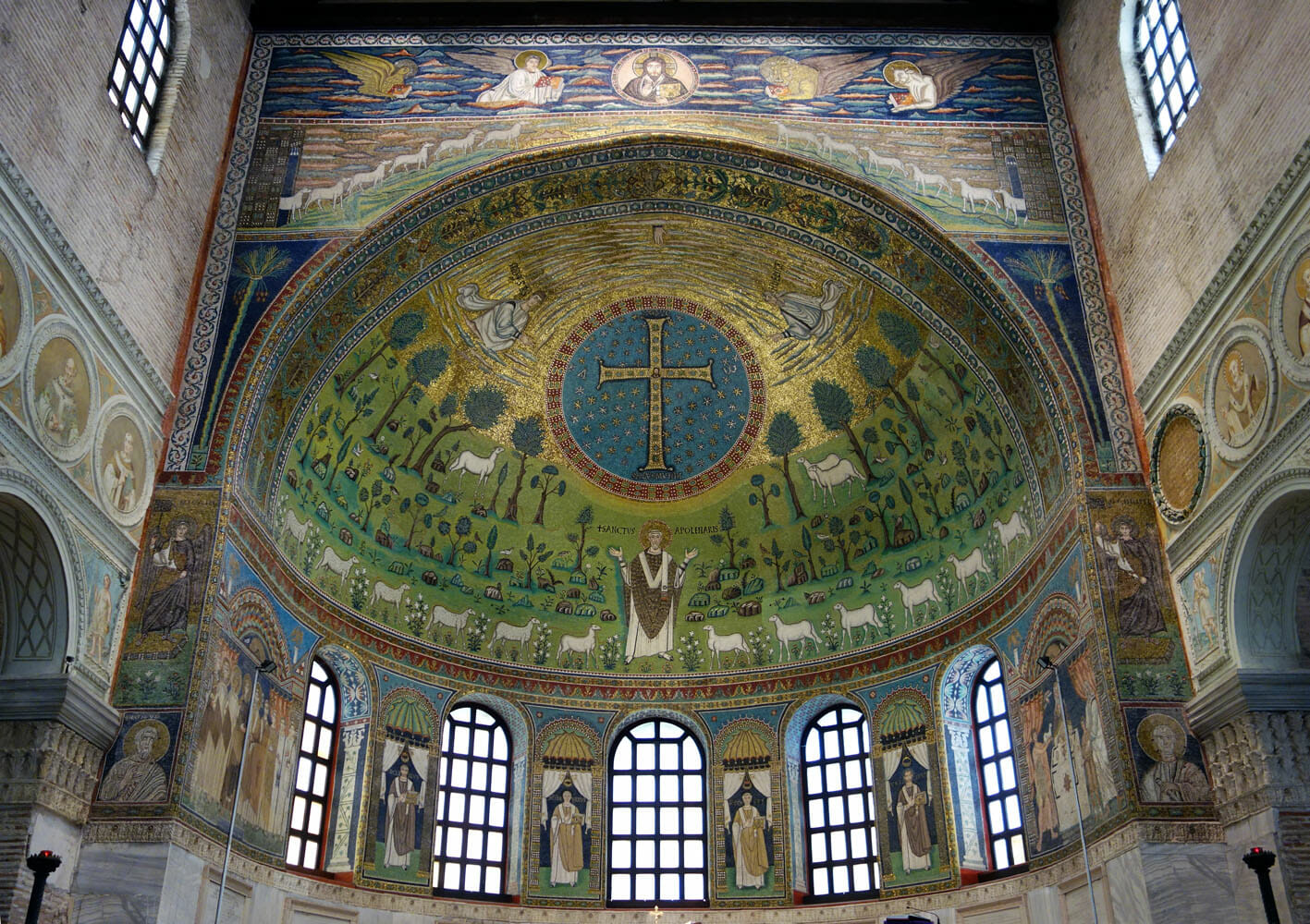 Apse mosaic of the Transfiguration, Sant’Apollinare in Classe, near Ravenna, Italy.
The apse mosaic of the Transfiguration at the Basilica of Sant’Apollinare in Classe has stuck with me the most out of all the early Christian monuments I saw in Ravenna, and indeed the most out of all the art that I saw while studying abroad in Venice.
The mosaic is highly idiosyncratic in how it depicts this scene from the Gospels, commonly represented in late antique and medieval art. Typically, the figure of Christ stands on the top of a mountain in the center, surrounded by a mandorla. The prophets Moses and Elijah flank him to the left and right, and Peter, James, and John are all below, often on the ground and covering their eyes. Often, though not always, a hand is visible at the top, hinting at God the Father, whose voice the three disciples hear in this scene.
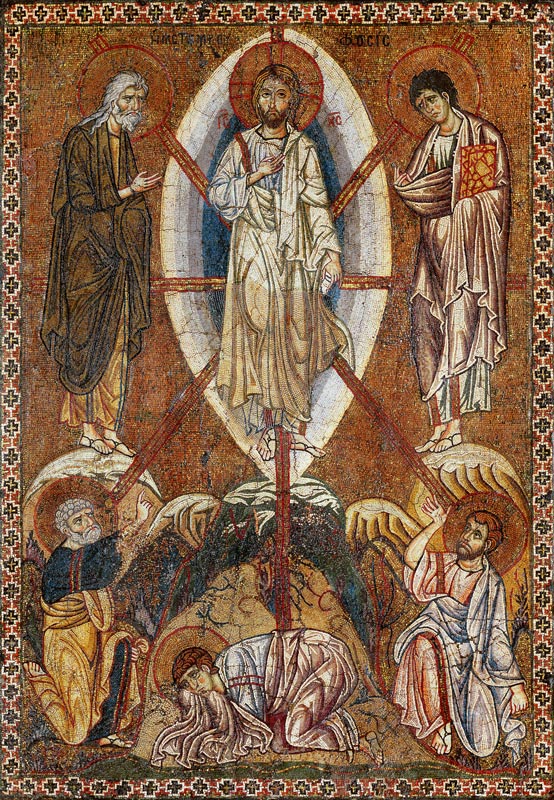
A typical depiction of the Transfiguration.
When first viewing this mosaic, however, it is actually not even obvious at all that it is depicting the Transfiguration. In the center is not the standing figure of Christ, but rather a large golden cross, set within a blue orb decorated with stars. Three sheep flank the cross, and it is set not on a mountain, but in a verdant garden or field set against a golden sky. Below the cross and the orb stands St. Apolenaris, traditionally the first bishop of Ravenna and who was said to be martyred there, in the orans pose. St. Apolenaris was, of course, not present at the Transfiguration!
There are several hints that give away what scene is being depicted in this mosaic, though. Most prominently are the figures of Moses and Elijah on either side of the orb. Second is the hand above the orb, which, as previously mentioned, likely indicates God the Father. We may notice that there are three sheep near the orb, cleanly mapping to the three disciples present at the Transfiguration. Finally, if one looks carefully at the center of the cross, one will spot Jesus’ head.
It is difficult to know where to start with why this piece is so meaningful to me. The first thing that comes to mind is how it plays with time. As previously mentioned, Saint Apolenaris was not present at the Transfiguration, and yet, as the patron saint of Ravenna and of the basilica, he acts as a sort of “gate” to these events. He, the first bishop of Ravenna, stands right above where the Eucharist is celebrated by the current bishop of Ravenna. Gathering 12 sheep around him, he lifts up his hands to the orb with the cross, as if presenting it or even carrying it. In this position he stands between the people of the basilica and the events of the Transfiguration, mediating or inviting the congregation into a direct and present experience of this event which occurred in the past.
And yet the image does not just establish a connection with the past to the congregation, but also with the future. The Greek characters alpha and omega which flank the cross evoke the book of Revelation, where St John hears Christ, in a vision of the end of time, proclaim that he is “the alpha and the omega, the beginning and the end”. The stars and deep blue of the orb in which the cross is set make one think of not the humble carpenter Jesus, but rather of the Son of God coming down from heaven. Even the setting of the verdant green field seem to hint at a return to a paradisaical garden. All in all, there seems to be a clear eschatological intent to much of the mosaic.
The mosaic, then, suggests to the viewer that these events are always already: the congregation is carried up into an experience of the past and of the future, and the past and future are brought down and made present. Time collapses into one moment, a glimpse into eternity.